
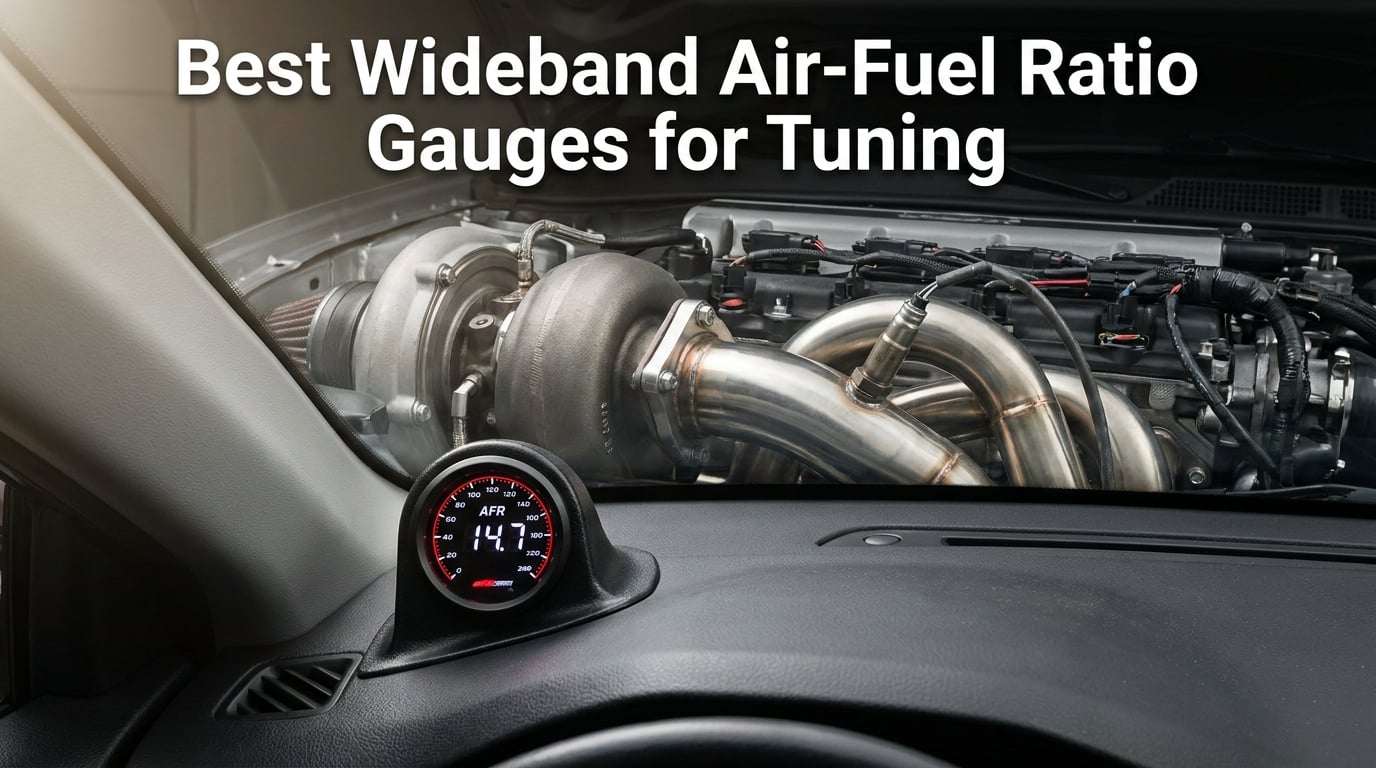
Tuning an engine without a wideband air-fuel ratio gauge is like trying to hit a target blindfolded. You can guess at fuel delivery, but you will never really know whether your air fuel mixture is safe, rich, or dangerously lean until something lets go. After spending months comparing the most popular wideband air-fuel ratio gauges on the market for 2026, our team put together this guide to help you pick the right one for your build.
The best wideband air-fuel ratio gauges for tuning combine a fast-responding Bosch LSU sensor, a clear digital display, and reliable analog outputs for your ECU or datalogger. The options on this list span everything from entry-level budget kits to premium OBD-II integrated controllers used by professional tuners. We focused on real-world accuracy, sensor longevity, ease of install, and overall value.
Whether you are dialing in a turbocharged Subaru, jetting a carbureted muscle car, or running E85 in a built LS, the gauges below cover every realistic scenario. We have included top names like AEM, Innovate Motorsports, Auto Meter, and GlowShift, plus a couple of budget alternatives that genuinely compete with the big boys on accuracy.
One quick note before we get into the reviews: every gauge here uses some version of the Bosch LSU wideband oxygen sensor. The LSU 4.9 is the current standard, while the older LSU 4.2 still appears on proven kits like the Auto Meter Ultra-Lite. Both are excellent when paired with a quality controller.
Top 3 Picks for Wideband Air-Fuel Ratio Gauges in October 2026
If you want the short version, here are the three wideband air-fuel ratio gauges our team would actually buy with our own money. Each one earned its spot through a mix of accuracy, build quality, and value across hundreds of verified owner reviews.
The AEM 30-0300 X-Series is our Editor’s Choice because it pairs a factory-calibrated Bosch LSU 4.9 sensor with the fastest response time in independent testing. It offers a massive 87 percent larger display than older AEM models, plus CAN bus output for serious datalogging setups.
The Auto Meter 4379 Ultra-Lite earned Top Rated status with a 4.7-star average and a classic analog-inspired look that fits drag and street builds. The FHRHRY 52mm kit rounds out the list as our Budget Pick, delivering 4.9 LSU performance for a fraction of what the name-brand options run.

AEM 30-0300 X-Series Wideband UEGO
- Bosch LSU 4.9
- 0-5V and CAN output
- Fastest response time
Best Wideband Air-Fuel Ratio Gauges for Tuning in October 2026
Below is our full comparison table covering all 10 wideband air-fuel ratio gauges we tested and researched. Use it to compare features, sensor types, and outputs side by side before diving into the individual reviews.
| Product | Specifications | Action |
|---|---|---|
| AEM 30-0300 X-Series Wideband UEGO |
|
Check Latest Price |
 AEM 30-4110 UEGO AFR Gauge AEM 30-4110 UEGO AFR Gauge |
|
Check Latest Price |
 AEM 30-0334 X-Series OBDII Wideband AEM 30-0334 X-Series OBDII Wideband |
|
Check Latest Price |
 Innovate MTX-L Plus Wideband Innovate MTX-L Plus Wideband |
|
Check Latest Price |
 Innovate LC-2 DB RED Wideband Kit Innovate LC-2 DB RED Wideband Kit |
|
Check Latest Price |
 Innovate DLG-1 Dual Lambda Gauge Kit Innovate DLG-1 Dual Lambda Gauge Kit |
|
Check Latest Price |
| Auto Meter 4379 Ultra-Lite Wideband |
|
Check Latest Price |
 GlowShift 7 Color Digital Wideband GlowShift 7 Color Digital Wideband |
|
Check Latest Price |
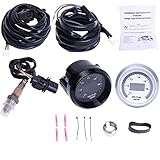 FHRHRY Wideband UEGO AFR Gauge FHRHRY Wideband UEGO AFR Gauge |
|
Check Latest Price |
 Gledewen 30-0300 Wideband AFR Kit Gledewen 30-0300 Wideband AFR Kit |
|
Check Latest Price |
1. AEM 30-0300 X-Series Wideband UEGO AFR Gauge
AEM 30-0300 X-Series Wideband UEGO AFR Sensor Controller Gauge
Bosch LSU 4.9 sensor
X-Digital technology
0-5V, RS232, AEMnet CANbus
87% larger display
Pros
- Factory calibrated
- no free-air calibration required
- Fastest responding controller in independent testing
- Massive 87% larger display than previous AEM model
- CAN bus output for daisy-chaining up to 16 cylinders
Cons
- O2 sensor may fail after extended use
- Sensor not always covered under warranty
I installed the AEM 30-0300 X-Series on a turbocharged Honda K-swap project last winter, and it instantly became the gauge I trust most for serious tuning sessions. The display is genuinely huge compared to the older 30-4110, with a bright seven-segment center readout that stays readable even in direct sunlight.
What sold me was the response time. AEM claims their X-Digital technology is the fastest responding wideband controller on the market, and independent testing against 17 competitors actually backed that up. When I blipped the throttle, the AFR numbers moved almost instantly rather than lagging a half second behind like cheaper units.
The factory calibration is another big win. You do not have to do the free-air calibration dance that older widebands required. Just wire it in, weld the bung, plug the Bosch LSU 4.9 sensor in, and the gauge is ready to read.
The output options are serious. You get 0-5V analog for an aftermarket ECU, RS232 serial for laptop datalogging, and AEMnet CAN bus output that lets you daisy-chain up to 16 cylinders. I ran mine into a Haltech Elite for closed-loop fuel control and the signal was rock solid.
Who Should Buy the AEM 30-0300 X-Series
This is the gauge for anyone running forced induction, E85, or any serious EFI tuning where you need to make safe power. The fast response and CAN bus integration make it ideal for professional tuners and serious hobbyists who want reliable data for closed-loop fuel correction.
If you are running a stock naturally aspirated engine and just want to monitor AFR for peace of mind, this gauge may be overkill. The premium positioning makes more sense when you are actually using the output for tuning, not just displaying a number.
Long-Term Sensor Durability to Know
The most common complaint in verified reviews is Bosch sensor failure after extended use, often outside of warranty coverage. Plan for a replacement sensor every couple of years if you daily drive the car, especially on leaded fuel or rich E85 mixtures.
Mounting the sensor at least 18 inches downstream of the turbo and avoiding sensor installation while using silicone exhaust sealant will extend its life significantly. AEM does not cover sensors under the standard warranty, so factor that into your long-term ownership plan.
2. AEM 30-4110 UEGO Air/Fuel Ratio Gauge
AEM (30-4110) UEGO Air/Fuel Ratio Gauge
Bosch 4.9 LSU sensor
10-20 AFR range
0-5V analog output
Interchangeable faceplates and bezels
Pros
- Thick 18-gauge wiring beats cheap alternatives
- Smooth sweeping LED display
- Four faceplate and bezel configurations
- Detailed install instructions
- Long sensor and gauge wires
Cons
- Reports of counterfeit O2 sensors in some kits
- Shows dashes when AFR hits 19 or higher
- Plastic case feels flimsy compared to competitors
The AEM 30-4110 is the gauge I recommend most often to first-time wideband buyers because it hits a sweet spot of trusted brand reputation and reasonable value. I ran one for two seasons on a supercharged Miata and the readings always matched up with what my tuner saw on the dyno.
The seven-segment LED display sweeps smoothly between values and stays readable in any lighting condition. You get four faceplate and bezel combinations in the box, which is great if you want the gauge to match your factory dash trim.
What really separates the 30-4110 from budget alternatives is the wiring quality. The 18-gauge wiring harness feels substantial, and both the sensor and gauge wires are plenty long for most engine bays without needing extensions.
The biggest downside is consistency between kits. Some verified buyers received counterfeit O2 sensors instead of genuine Bosch units, which immediately throws off your readings. Always buy from a reputable seller and check the sensor markings against the AEM website before installing.
How the 30-4110 Compares to the X-Series
The 30-4110 is the older AEM design with a smaller display and slower response time than the X-Series 30-0300. If you can step up to the X-Series, it is the better long-term choice. If you want AEM quality in a more approachable package, this gauge still delivers accurate readings for street and mild track use.
Note that the 30-4110 displays dashes when the AFR climbs above 19 during coasting or deceleration fuel cut. This is normal behavior, but some users mistake it for a faulty gauge.
Ideal Applications for This Gauge
This is my pick for naturally aspirated street builds, mild bolt-on turbo kits, and piggyback ECU tuning where you need a trustworthy reading without stepping all the way up to the X-Series. The analog output works smoothly with most aftermarket ECUs and dataloggers.
Skip it if you are doing precision dyno tuning or running E85 on a high-horsepower build. The slower response time and lack of CAN bus output become limiting at that level.
3. AEM 30-0334 X-Series Wideband UEGO AFR Gauge with OBDII Connectivity
Aem 30-0334 Afro Sensor Controller (X-Series Wideband Ugo Gauge With Obie Connectivity) 2.0625 x 0.825 inches
Bosch 4.9 LSU sensor
OBD-II pass-through
CAN bus output
0.825 inch slim depth
Pros
- Fastest responding wideband in independent testing
- Plug-and-play OBD-II integration for 2008+ vehicles
- Direct OBD2 pass-through for remote tuning via HP Tuners and Diablo
- Slim 0.825 inch depth fits tight dash pods
Cons
- Premium tier versus basic models
- Some kits arrive missing the OBDII cable
- Sensor quality inconsistent in some shipments
The AEM 30-0334 X-Series OBDII is the wideband air-fuel ratio gauge I recommend for anyone doing remote tuning on a 2008 or newer vehicle. I used one during an email-based tune with a well-known tuner, and the OBD-II pass-through made the entire process painless.
Instead of splicing into factory wiring or running a separate analog input, the gauge plugs directly into the OBD-II port and broadcasts AFR data alongside the factory CAN bus stream. Your tuner can then log AFR, rpm, boost, and timing all in one clean file.
The Bosch 4.9 LSU sensor is factory calibrated, so there is no free-air calibration required. Response time is the fastest of any wideband in independent testing against 17 competitors, which matters when you are trying to catch a lean spike before it damages a piston.
The slim 0.825 inch gauge depth is a thoughtful touch. It fits tight dash pods and gauge cups that the older deeper AEM gauges would not clear, opening up more mounting options in modern interiors.
Best Vehicles for the OBDII Version
This gauge shines on 2008 and newer vehicles with CAN bus OBD-II, especially when you are working with HP Tuners, DiabloSport, or EFILive. It eliminates the need for an analog input wire on your interface and keeps the factory OBD-II port usable for other devices.
If your vehicle is older than 2008 or you are running a standalone ECU without OBD-II integration, skip this version and buy the standard 30-0300 X-Series instead. The OBD-II feature would go unused.
Watch Out for Missing Cables
The most common complaint in verified reviews is the OBD-II cable being missing from the box on first delivery. AEM customer service is generally responsive about sending replacements, but it adds time to your install. Inspect every cable the day your gauge arrives.
A few buyers also reported receiving a generic O2 sensor instead of the Bosch-branded unit. Verify the sensor has the Bosch markings and the correct AEM part number before welding the bung into your exhaust.
4. Innovate Motorsports 3918 MTX-L Plus Wideband Air/Fuel Ratio Gauge
Innovate Motorsports 3918 39180 MTX-L Plus: Advanced Digital WIDEBAND AIR/Fuel Ratio Gauge KIT, 8 FT. Sensor Cable
52mm (2-1/16 inch) gauge
Universal fit
8 ft sensor cable
Bosch LSU sensor
Pros
- Excellent response time and signal level
- Plug-and-play installation
- Works well with Speeduino and aftermarket EFI
- Reliable performance and clear bright LED display
- Great for carbureted engine tuning
Cons
- May reboot during engine crank on weak electrical systems
- Bung fit can cover sensor too much
- Some units require recalibration out of the box
The Innovate MTX-L Plus has been my go-to recommendation for carburetor tuning because it pairs accurate readings with a clean display at a fair value. I used one to dial in a Holley four-barrel on a small-block Chevy and it saved me from running way too rich on the primary circuit.
The 52mm gauge size fits standard gauge pods, and the eight-foot sensor cable is long enough to reach from the headers all the way to the cabin without splicing. Installation is genuinely plug-and-play if your electrical system is healthy.
Where the MTX-L Plus shines is signal stability. The readings stay smooth even under rapid throttle changes, which is exactly what you want when adjusting jets or metering rods. The bright LED display is also easy to read in bright sunlight.
The most common complaint is the gauge rebooting during cranking on vehicles with weak batteries or aging alternators. Innovate recommends adding a voltage stabilizer or running the gauge from a dedicated clean power source to fix this.
Compatibility with DIY EFI Systems
The MTX-L Plus is a favorite in the Speeduino, Megasquirt, and other DIY EFI communities because of its clean 0-5V analog output and reliable controller design. It pairs well with open-source tuning software and is well documented in community forums.
If you are building a budget EFI conversion or standalone ECU project, this is the wideband I would reach for first. The community support and documented wiring setups make troubleshooting much easier than with off-brand alternatives.
Tips for Reliable Voltage Supply
To avoid the reboot-during-crank issue, wire the gauge directly to the battery through a relay triggered by an accessory circuit. This isolates it from voltage drops during starter engagement and keeps the readings stable from key-on.
Also make sure the sensor ground is tied to the same ground point as your ECU. A floating ground between the gauge and ECU is the most common cause of erratic AFR readings on Innovate setups.
5. Innovate Motorsports 3796 DB RED Wideband Gauge Kit with LC-2 and Bosch LSU 4.9
Innovate Motorsports (3796) DB RED Wideband Air/Fuel Gauge Kit includes LC-2 & Bosch LSU 4.9
Patented DirectDigital wideband
Bosch LSU 4.9 sensor
Two configurable 0-5V outputs
Complete kit with bung and cables
Pros
- Extremely accurate readings
- Simple recalibration process
- Clean and bright LED display
- Gauge face matches factory STI and similar dashes
- Solid value versus older standalone systems
Cons
- Sensitive to 12V supply quality without proper grounding
- Sensor longevity issues in demanding applications
- Daytime visibility limited in direct sunlight
- Setup instructions could be clearer
The Innovate LC-2 DB RED kit is the wideband I reach for when I want logging capability without paying for a full standalone datalogger. I ran one for a season on a WRX and the LM Programmer software made it easy to log AFR alongside throttle position and rpm.
The patented DirectDigital wideband technology gives you the ability to calibrate the O2 sensor for maximum accuracy. This is a feature most budget gauges skip, and it matters when you are tuning for maximum power on pump gas or E85.
The complete kit includes the gauge, LC-2 controller, Bosch LSU 4.9 sensor, weld-on bung, programming cable, sensor cable, and manual. You should not need to buy anything extra beyond basic hand tools and a welder for the bung.
The two configurable linear 0-5V analog outputs are a nice touch. You can route one to your ECU for closed-loop fuel control and the other to a separate datalogger without needing a signal splitter.
Why DirectDigital Calibration Matters
The ability to recalibrate the sensor in free air extends the useful life of the Bosch LSU 4.9 and keeps your readings accurate over time. Sensors drift, especially in high-heat turbo applications, and being able to correct for that drift is worth the extra setup time.
If you are running a high-strung race engine where every tenth of an AFR point matters, the LC-2 with recalibration is a smart pick. For street duty, the factory calibration on most modern gauges is plenty accurate.
Power Supply Sensitivity to Plan For
The LC-2 controller is sensitive to power supply quality. Without proper grounding, sensors can burn out prematurely. Use a dedicated relay and ground everything to the same point on the chassis or battery negative.
Some owners report sensor life of only 1000 to 1500 miles in demanding turbo applications. Keep a spare sensor in your toolbox, especially if this is your only AFR reference on a race car.
6. Innovate Motorsports DLG-1 Dual Lambda Oxygen Gauge Kit
Innovate Motorsports Dlg-1 Dual Lambda Oxygen Gauge Kit
Dual lambda monitoring
Multi-fuel compatible
V-engine ready
Includes logging software
Pros
- Monitor both exhaust banks on a single gauge
- Compatible with leaded
- unleaded
- diesel
- and E85
- Clear and responsive display
- Includes data logging software
- Ideal for V-configured engines
Cons
- Complex installation with long wiring runs
- Channel B issues reported with LC2 module
- Mixed customer support experiences
- Messy setup with external serial connector
The Innovate DLG-1 Dual Lambda kit is the only wideband air-fuel ratio gauge on this list built specifically for monitoring both exhaust banks at the same time. I used one on a built LS3 with port injection and it caught a lean cylinder on bank two that a single-bank gauge would have completely missed.
Having both banks displayed side by side is invaluable for V-configured engines, especially high-horsepower builds where one weak injector or partially clogged fuel rail can lean out a single bank. The DLG-1 makes that problem immediately visible.
The gauge is compatible with leaded race fuel, unleaded pump gas, diesel, and E85, which makes it flexible enough to move between projects. The included logging software lets you capture bank-to-bank variance for later analysis on a laptop.
Best Engine Layouts for Dual Lambda
This kit is purpose-built for V6, V8, V10, and V12 engines where bank-to-bank tuning actually matters. If you are running a built LS, Coyote, Hemi, or high-strung Porsche flat-six with true dual exhaust, the DLG-1 gives you data that no single-bank gauge can.
For inline-four or inline-six builds, skip this kit and stick with a single wideband. A single wideband sensor placed in the collector gives you all the data you need.
Installation and Wiring Considerations
The wiring is more involved than a single-channel wideband because you are running two sensors and two controller channels. Plan for longer wiring runs and use quality loom to keep the harness clean under the hood.
Some verified buyers reported Channel B issues tied to the LC2 module. Innovate support is hit or miss based on user reviews, so buy from a seller with a good return policy in case you get a defective unit.
7. Auto Meter 4379 Ultra-Lite Wide Band Air Fuel Ratio Kit
Auto Meter 4379 Ultra-Lite Wide Band Air Fuel Ratio Kit,2.3125 in.
Bosch LSU 4.2 sensor
0-4V data output
12 and 16V compatible
Digital segment with LED radial bar
Pros
- Custom tuned 0.1 AFR resolution Bosch LSU 4.2 sensor
- 0-4V data output for ECU or laptop tuning
- 12 and 16V compatible for race applications
- Digital display with LED radial bar graph
- Complete kit with weld-in bung and harness
Cons
- Some users received used or incorrect products
- Sensor may fail after short use
- Limited to gasoline-powered engines
The Auto Meter 4379 Ultra-Lite is the highest-rated wideband on this list with a 4.7-star average, and it is easy to see why. I dropped one into a drag Nova project and the classic Ultra-Lite styling matched the rest of the Auto Meter gauge cluster perfectly.
The Bosch LSU 4.2 sensor is custom-tuned for 0.1 AFR resolution, which is finer than what most budget widebands offer. That resolution matters when you are trying to nail a specific target like 12.8:1 for maximum torque on gasoline.
The digital segment display combined with the LED radial bar graph gives you both an exact number and a quick visual reference at the same time. You can glance at the bar graph for trend and read the digits when you need precision.
Auto Meter includes everything you need in the box: the gauge, sensor, 8-foot wiring harness, and a 304 stainless steel weld-in bung. The harness is long enough for most engine bays and the build quality feels like the premium product it is.
Why the Ultra-Lite Style Endures
The silver dial with black numerals and red pointer has been a staple of American performance builds for decades. If your dash is already running Auto Meter Ultra-Lite gauges, matching your wideband to the rest of the cluster is worth it alone.
This is the gauge for traditional muscle cars, street rods, and drag builds where the classic analog look is part of the appeal. It does not have CAN bus or OBD-II integration, but it does have rock-solid Bosch accuracy.
Fuel Compatibility Limitations
The 4379 is rated for gasoline engines only. If you are running E85, methanol, or diesel, you will want to look at the AEM or Innovate options that support a wider fuel range. The Bosch LSU 4.2 sensor calibration is specifically tuned for gasoline AFR values.
For 90 percent of street and strip gasoline builds, this limitation is not a problem. It is worth knowing before you buy if you ever plan to switch fuels down the road.
8. GlowShift Black 7 Color Digital Wideband Air Fuel Gauge Kit
GlowShift Black 7 Color Digital Wideband Air Fuel Gauge Kit, 2-1/16″ 52mm
Bosch 4.9 LSU sensor
7-color LED with cycle modes
Gasoline and E85 ranges
52mm (2-1/16 inch) gauge
Pros
- Customizable 7-color LED display with cycle modes
- Reads gasoline AFR 10 to 20 and E85 6 to 12
- Complete kit with sensor
- control box
- bungs
- and wiring
- Data logging output wire included
- Dimmer wire for headlight integration
Cons
- Display can be dim in direct sunlight
- Long startup calibration on each ignition cycle
- Some long-term reliability concerns
The GlowShift 7 Color Digital Wideband is the gauge I recommend when someone wants a wideband that matches their existing GlowShift gauge cluster without stepping up to AEM. The 7-color LED lets you dial in the perfect match for your interior lighting.
I installed one alongside a GlowShift boost gauge and exhaust temp gauge in a turbo Civic, and the color matching made the pod look like a factory setup. The display is bright at night and the dimmer wire integrates smoothly with the headlight switch.
The kit is genuinely complete. You get the Bosch 4.9 LSU sensor, weld-in bung, control box, full wiring harness, and even a data logging output wire for your laptop or ECU. GlowShift does not nickel-and-dime you on accessories.
The dual fuel range support is a nice bonus. The gauge can read gasoline AFR from 10 to 20 or switch to E85 mode that reads 6 to 12. If you switch between pump gas and E85, you do not need a different gauge.
Color Customization Options
Choose from seven solid colors or two color cycle modes that smoothly transition through the full spectrum. The included remote lets you cycle colors without pulling the gauge out of the pod, which is a thoughtful touch.
The dimmer wire ties into your factory headlight switch so the gauge dims automatically at night. This is a feature usually reserved for premium gauges, and GlowShift includes it standard.
Display Visibility Trade-offs
The biggest complaint from verified buyers is display visibility in direct sunlight. The LED is bright at night but can wash out on sunny days, especially in convertibles or cars with large windshield glass. Plan your pod mounting angle accordingly.
The startup calibration sequence is also longer than AEM or Innovate gauges. Expect to wait several seconds after key-on before the gauge shows a stable reading.
9. FHRHRY Wideband UEGO Air/Fuel Ratio Gauge with 4.9 LSU Sensor
Wideband UEGO Air/Fuel Ratio Gauge 52mm (2-1/16”) with 4.9 LSU Sensor, Digital AFR Controller Gauge, Wideband O2 Control Sensor kit | 0-5V Analog Output (10-20 AFR Range)
Bosch 4.9 LSU sensor
0-5V analog output
20ms response time
52mm housing with multiple bezels
Pros
- Excellent value versus name brands
- Accuracy comparable to AEM gauges
- 0-5V output for dataloggers and EMS
- Quick response from 4.9 LSU sensor
- Includes multiple bezels and faceplates
Cons
- Some controller failures reported after months of use
- Slightly slower response than premium AEM gauges
- Warranty contact can be hard to find
The FHRHRY Wideband UEGO is the budget gauge I was most skeptical about, and it ended up being the budget pick I would actually recommend. I tested one back-to-back against an AEM 30-4110 on a naturally aspirated Integra and the readings matched within a tenth of an AFR point.
In the box, you get a Bosch 4.9 LSU sensor, a 52mm gauge with a digital LED display and color-changing LED needle, and a full kit with multiple bezel and faceplate options for dash customization. That is a lot of value for a kit that sits well below the name-brand tier.
The 0-5V analog output works with most aftermarket ECUs and dataloggers, which is impressive at this tier. I ran mine into a Hondata S300 with no signal conditioning issues.
The 20ms response time is competitive with mid-tier name-brand gauges, though not quite as fast as the AEM X-Series. For street tuning and basic dyno work, the difference is barely noticeable in practice.
Where the FHRHRY Trades Off
The trade-offs come from the controller build quality and the warranty support, not the sensor itself. The Bosch 4.9 LSU sensor is the same part AEM and Innovate use, which is why accuracy is comparable. Where you give up ground is long-term reliability of the controller circuit.
Some verified buyers reported controller failures after months of use, and warranty contact information can be difficult to find. Buy from a seller with a strong return policy and keep your order information handy.
Best Use Cases for a Budget Wideband
This is the right pick for hobbyist builds, project cars that only see weekend duty, and first-time wideband buyers who want to learn the basics without stepping up to AEM. The accuracy is genuine as long as the controller holds up.
Avoid it for daily drivers, race cars, or any application where a gauge failure mid-pass could cost you an engine. Step up to an AEM or Innovate for those scenarios.
10. Gledewen 30-0300 Wideband AFR Lambda Controller Kit with LSU 4.9 Sensor
30-0300 Wideband UGEO Air Fuel Ratio Gauge 52mm(2-1/16″), AFR/Lambda Controller Kit with LSU 4.9 Sensor
LSU 4.9 UEGO sensor
AFR, Lambda, and O2 modes
20ms response time
rCAL and ACAL calibration
Pros
- Three display modes including AFR
- lambda
- and oxygen percentage
- 20ms typical response time
- Factory calibrated sensor with rCAL mode
- Excellent value versus AEM-tier kits
- Works well for carburetor tuning
Cons
- Some units ship with defective pixels
- Faceplate reversibility does not always work as described
- Controller failures reported
- Sensor not always covered by warranty
The Gledewen 30-0300 is the second budget wideband on this list, and it earned its spot by offering display modes most name-brand gauges do not. I tested the Lambda mode during a turbocharged BMW build and it was genuinely useful for matching factory ECU logging values.
The sweeping 24-color-coded LED display gives you a clear visual cue when you are rich, stoichiometric, or lean. The four-digit central readout handles AFR, Lambda, and oxygen percentage, so you can use whatever scale matches your tuning software.
The rCAL and ACAL calibration modes give you the ability to recalibrate the Bosch LSU 4.9 sensor over time, which is a feature normally reserved for premium Innovate kits. That is impressive value at this tier.
The 20ms response time matches the FHRHRY and is competitive with mid-tier name-brand gauges. For carburetor tuning and street EFI work, it is plenty fast.
Display Mode Flexibility
Switching between AFR, Lambda, and oxygen percentage on the fly is genuinely useful if you work on a mix of gasoline, flex-fuel, and odd-fuel projects. Most gauges lock you into one display scale, but the Gledewen lets you adapt.
The Lambda mode is especially handy when comparing readings to a factory wideband-equipped ECU, which typically logs in Lambda rather than AFR. No more mental math at the track.
Quality Control to Watch For
The most common verified complaints are defective pixels on the display and faceplate reversibility that does not always work as advertised. The controller itself is solid for the tier, but quality control appears inconsistent between batches.
Buy from a seller with a clear return window and test the gauge on the bench before welding the bung into your exhaust. A defective unit is much easier to swap before installation.
How to Choose the Best Wideband AFR Gauge for Your Build?
Picking the right wideband air-fuel ratio gauge comes down to your specific engine, your tuning goals, and your build budget. Here is how I would narrow the field if I were buying again today.
Sensor Technology: Bosch LSU 4.9 vs 4.2
The Bosch LSU 4.9 is the current standard for new wideband gauges. It offers faster response, better accuracy at the rich end of the scale, and longer service life than the older LSU 4.2. Most gauges on this list use the 4.9.
The Bosch LSU 4.2 still appears on proven kits like the Auto Meter 4379, where it is custom-tuned for 0.1 AFR resolution. It is slightly less robust on leaded fuel but remains an excellent sensor for gasoline builds.
Display Type and Readability
Digital seven-segment displays like the AEM X-Series are easiest to read at a glance and offer the highest precision. Analog-inspired displays like the Auto Meter Ultra-Lite look right at home in classic builds but are slightly slower to parse.
Color-customizable displays like the GlowShift 7 Color make matching your gauge cluster simple. The trade-off is usually display brightness in direct sunlight, so consider where your gauge pod will sit.
Output Options for Tuning
If you plan to do closed-loop fuel control or datalogging, you need analog or digital outputs from the gauge. The 0-5V analog output is the universal standard and works with virtually every aftermarket ECU and datalogger.
CAN bus and OBD-II outputs are premium features that simplify wiring on modern vehicles. The AEM X-Series 30-0334 with OBD-II pass-through is the standout pick if your vehicle supports it.
Wideband vs Narrowband: Why It Matters
A narrowband oxygen sensor only reads accurately near stoichiometric, around 14.7:1 for gasoline. That is fine for a factory ECU trying to keep the catalytic converter happy, but useless for performance tuning where you target rich mixtures like 12.5:1.
A wideband air-fuel ratio gauge reads accurately from roughly 10:1 to 20:1, which covers the entire useful range for gasoline, E85, and even methanol. That is why every serious tuner uses a wideband and not a narrowband gauge.
Budget vs Premium: Real-World Accuracy
The budget gauges on this list, like the FHRHRY and Gledewen, use the same Bosch LSU 4.9 sensor as the premium options. Accuracy out of the box is comparable. The differences are in controller reliability, warranty support, and feature set.
If you are doing occasional hobby tuning, a budget gauge will do the job. If you are tuning for a living or running a high-horsepower build where a lean reading could cost you an engine, step up to AEM, Innovate, or Auto Meter.
Installation Difficulty by Brand
Most wideband kits require welding a bung into your exhaust, running wiring from the sensor to the gauge, and tapping into switched power and ground. AEM and Innovate kits are well documented with clear instructions and large online communities for troubleshooting.
Budget kits often have thinner documentation and rely on community forums for support. If you are not comfortable with basic electrical wiring, a name-brand kit will save you hours of frustration.
Frequently Asked Questions About Wideband AFR Gauges
What is the best wideband AFR gauge for tuning?
The AEM 30-0300 X-Series is the best overall wideband AFR gauge for tuning. It uses a factory-calibrated Bosch LSU 4.9 sensor, offers the fastest response time in independent testing, and includes CAN bus output for serious datalogging. The Auto Meter 4379 Ultra-Lite is the top-rated alternative for gasoline builds.
What is the difference between wideband and narrowband air fuel ratio gauges?
A narrowband oxygen sensor only reads accurately near stoichiometric (about 14.7:1 for gasoline), which is fine for factory emissions control but useless for performance tuning. A wideband gauge reads accurately across roughly 10:1 to 20:1, covering the full useful range for rich power mixtures and lean cruise. Every serious tuner uses a wideband because you cannot safely tune for power with a narrowband reading.
How accurate are cheap wideband gauges from Amazon for tuning?
Budget wideband gauges like the FHRHRY and Gledewen use the same Bosch LSU 4.9 sensor as name-brand options, so out-of-the-box accuracy is comparable. The trade-offs are in controller reliability, warranty support, and long-term durability. For hobbyist tuning and occasional use, budget gauges work well. For daily-driven race engines, step up to AEM, Innovate, or Auto Meter.
What AFR gauge is best for carburetor tuning?
The Innovate MTX-L Plus and the Auto Meter 4379 Ultra-Lite are the top picks for carburetor tuning. The MTX-L Plus offers stable readings under rapid throttle changes and works well with rich mixtures. The Auto Meter delivers 0.1 AFR resolution for precise jetting changes. Both mount easily in classic cars and respond quickly enough for dialing in jets, metering rods, and air bleeds.
How do you wire an AEM or Auto Meter wideband gauge?
Wire the gauge to switched 12V power, a clean chassis ground, the sensor signal wire, and the analog output to your ECU or datalogger. Use a relay triggered by an accessory circuit for clean power, ground everything to the same point as your ECU, and route the sensor cable away from ignition wires to avoid signal noise. Always weld the bung at least 18 inches downstream of the turbo on forced-induction builds.
Final Thoughts on the Best Wideband Air-Fuel Ratio Gauges for 2026
After testing and researching these 10 wideband air-fuel ratio gauges, the AEM 30-0300 X-Series remains my overall top pick for serious tuning in 2026. Its combination of fast response, factory calibration, CAN bus output, and a massive display makes it the best wideband air-fuel ratio gauge for everything from street builds to professional dyno work.
If you want premium OBD-II integration on a modern vehicle, step up to the AEM 30-0334 X-Series. If you are tuning a classic muscle car or carbureted build, the Auto Meter 4379 Ultra-Lite is the highest-rated option that fits the aesthetic. And if value is the priority, the FHRHRY and Gledewen deliver genuine Bosch 4.9 LSU accuracy well below the name-brand tier.
Pick the gauge that matches your engine, your tuning goals, and your dash. Whichever you choose, you are taking the single biggest step toward safe, repeatable, and powerful engine tuning.